Wholesale buyers need more than a color name before committing to a container, crate, or production lot. You will be able to define the stone, approve realistic variation, assess performance by application, and compare suppliers using specifications that protect your margins.
Key takeaways
- Confirm geology, quarry origin, dimensions, and current-lot colour before comparing prices.
- Request a sample, finish specification, tolerances, and packing details for every bulk offer.
- Use leather-finish stone only after checking slip, staining, drainage, and maintenance conditions.
- Give retailers care instructions and show natural colour variation before they promise uniform results.
Define the Stone Before You Compare Wholesale Offers
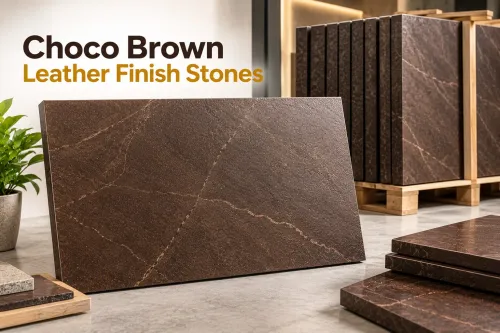
Confirm the stone’s geology, finish, dimensions, and current-lot appearance before comparing prices. “Choco brown” is a trade colour name, not a geological classification or fixed international shade. The material could be Tandur limestone, another limestone, or a different natural stone, so the offer must identify the stone and quarry or origin.
For choco brown leather finish stones for wholesalers, request:
- A dated slab or paving mock-up from current inventory, plus lot photographs.
- The base tone and expected shade range, including veining, fossils, pits, open pores, and colour concentration.
- Nominal thickness, available slab or tile sizes, calibrated or uncalibrated status, edge treatment, and stated length and width tolerances.
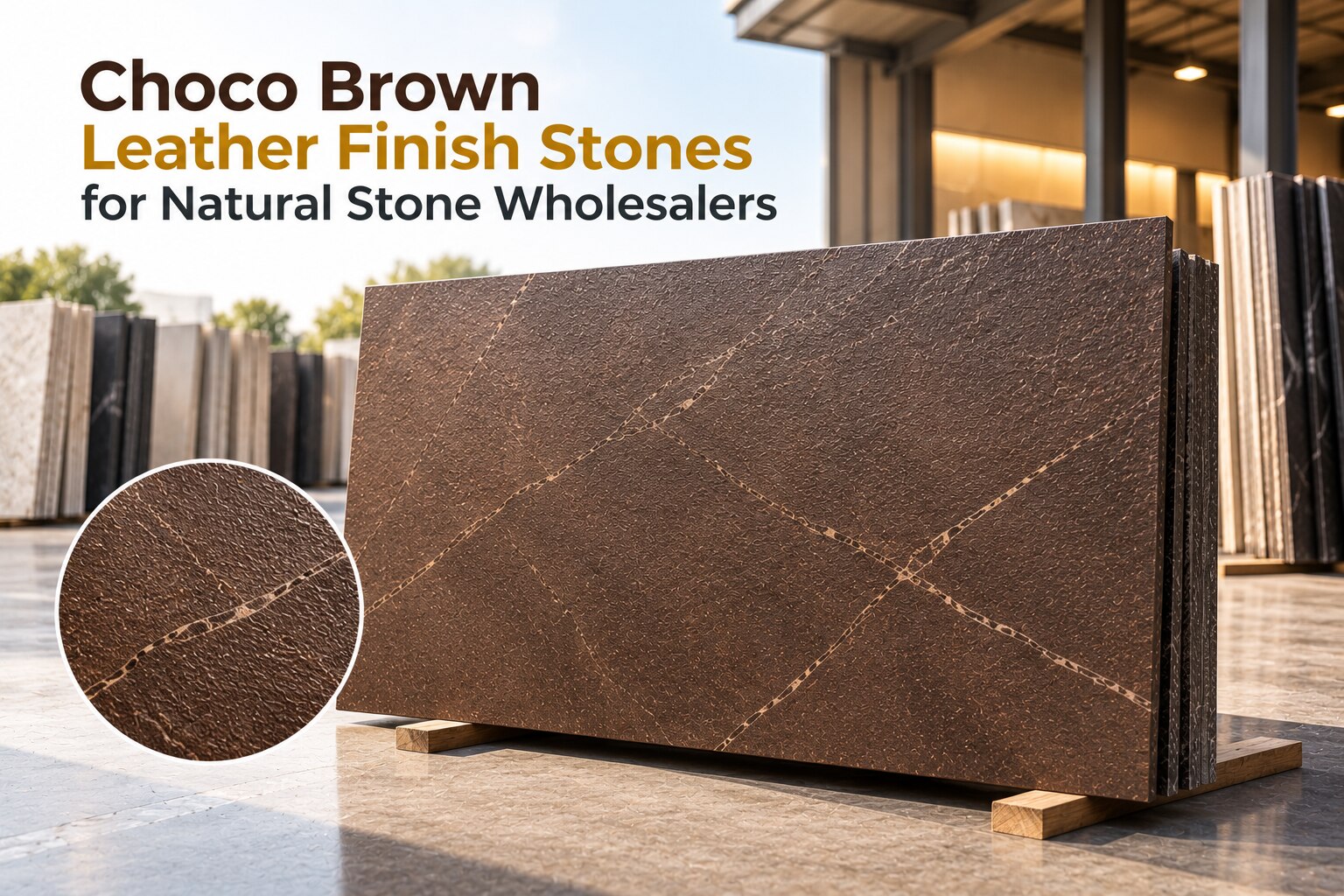
- A description of the leather finish’s surface relief, roughness, reflectivity, and slip feel, rather than calling it simply textured.
- A sample approval condition stating whether bulk colour can vary from the showroom sample and whether replacement from another lot is allowed.
| Offer detail | Confirm before comparing choco brown leather finish stones wholesale | Why it matters |
|---|---|---|
| Material identity | Tandur limestone, another limestone, or another stone; include origin | Colour names can conceal different absorption and durability |
| Appearance | Approved dated sample and defined lot variation | One small sample cannot guarantee uniform bulk colour |
| Surface and edges | Leathered face, edge finish, and relief consistency | Finish changes cleaning, handling, and fabrication |
| Supply specification | Pieces per crate, packaging, lead time, and replacement terms | The lowest rate may not represent equivalent delivered stock |
Never approve colour from a catalogue image alone. A job-site mock-up should also test grout residue, cleaning, and sealer compatibility.
What the Leather Finish Changes in Use and Fabrication
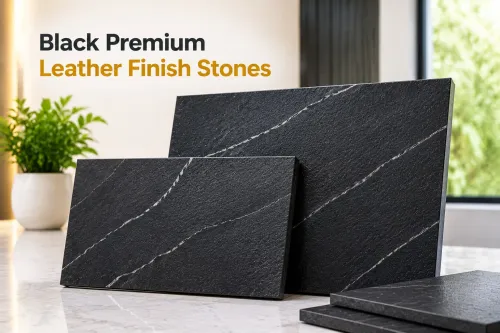
Expect a low-sheen surface with shallow relief, not a uniformly rough coating. Processors create a leather finish by brushing or abrasive tooling after sawing and usually honing the stone; residual pits, texture depth, and gloss therefore vary between lots and processors.
The surface feels more tactile than honed stone, disguises fingerprints and fine scratches, but can hold dust, grout haze, grease, and soil in its depressions.
Fabrication requires a clean sample approval before cutting choco brown leather finish stones bulk. Texture can make pencil lines, suction cups, seam alignment, and adhesive coverage less predictable, while cut edges remain comparatively smooth unless the fabricator finishes them separately.
Request an edge sample and test the intended sealer: acid cleaners can etch limestone, and excess sealer can collect in the texture.
Wholesalers can confidently position finished material for these uses when the stone’s technical results and thickness match the project:
- Interior feature walls, fireplace surrounds, and commercial reception walls
- Residential floors and low-to-moderate traffic interior floors
- Vanity tops, hearths, and other surfaces where the owner accepts natural variation
- Covered patios or sheltered paving after confirming wet-slip performance and installation details
Do not call the finish stain-proof, maintenance-free, or slip-proof. “Leather” describes appearance and texture, not a performance grade; wet traction depends on the actual stone, relief, contamination, slope, joints, and cleaning. Retailers need those limits in writing.
Match the Stone to Wet, Outdoor, and High-Use Conditions
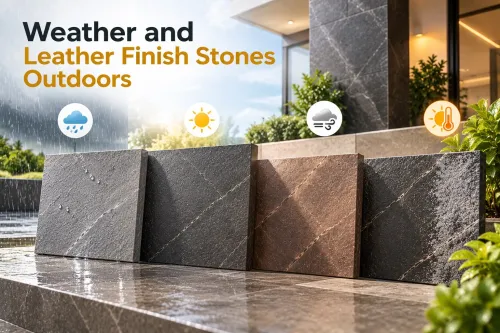
Wet areas need a measured slip result, not a finish label. Request a recognized wet-slip test for the actual leathered product, then assess the installed slope, joint spacing, drainage, and cleaning regime. Soap, dust, algae, and polishing residue can reduce traction even when the stone has visible texture.
| Installation condition | Performance checks to request | Decision point |
|---|---|---|
| Wet floors, bathrooms, and pool surrounds | Wet slip test on the finished surface; texture depth; water drainage; joint layout; acid and cleaner resistance | Reject an offer supported only by “leather” or “non-slip” wording |
| Exterior paving and steps | Abrasion resistance; water absorption; weathering or freeze-thaw data where relevant; wet slip result; thickness and breaking strength | Confirm the stone, joints, and sub-base can drain water without creating slippery films |
| High-use floors, entrances, and commercial areas | Abrasion or wear test; breaking strength; thickness consistency; stain resistance; replacement-lot policy | Choose a tested grade that will retain texture and appearance under traffic |
| Counters and hearths | Stain testing; acid sensitivity; heat and edge-treatment review; cleanability | Avoid it where spills, acids, or maintenance limits conflict with the intended use |
For choco brown leather finish stones bulk purchases, compare the test report with the exact lot, thickness, and processor—not a similar sample. Ask for a current-inventory sample and lot photographs before approving choco brown leather finish stones for wholesalers.
A leather finish improves tactile grip but does not make limestone stain-proof, maintenance-free, or suitable for every exterior exposure.
The Wholesale Specification and Supplier Documents to Request
Do not release a purchase order until the choco brown leather finish stones supplier converts the colour name into a dated, measurable specification. “Choco brown” is a trade description, not a fixed geological shade; the paperwork must identify whether the material is Tandur limestone, another limestone, or a different natural stone.
1. Request a current-inventory sample, dated slab or paving mock-up, and photographs of the actual lot. Record acceptable variation in brown base tone, veining, fossils, pits, and shade range; do not approve bulk colour from a small showroom piece.
2. Require a commercial specification stating product form, nominal thickness, calibrated or uncalibrated status, length and width tolerances, face and edge finish, acceptable bowing, pieces per crate, and whether another lot can replace rejected material.
3. Ask for quarry or origin information, available slab or tile dimensions, relevant test reports, lead time, packing photographs or crate details, breakage terms, and a written replacement policy. For choco brown leather finish stones wholesale, these documents are more useful than a colour swatch alone.
4. Approve a job-site mock-up before buying: test the proposed grout, cleaning method, dwell time, and sealer on the textured face. The supplier must identify whether its recommended sealer is penetrating or topical and provide a product-specific test panel, because sealing can darken the stone or pool unevenly in deeper relief.
If you are comparing Agarwal Stone Company with another source, send both suppliers the same specification and approval sample; otherwise, different thicknesses, tolerances, and lots can make quotations look cheaper without being equivalent.
Help Retailers Sell the Stone Without Overpromising
A retailer needs more than the name “choco brown.” Stock supplied as leather finish stones for retailers should include the current lot number, quarry or origin, photographs, sample approval record, thickness, calibrated or uncalibrated status, edge finish, packaging count, lead time, and replacement policy.
A choco brown leather finish stones supplier should also provide relevant wet-slip, absorption, or freeze-thaw test results for the actual finished product.
Give customers a care sheet with these instructions:
- Clean with a pH-neutral stone cleaner and soft brush; remove grit before it abrades the raised texture.
- Keep acids, vinegar, lemon cleaners, and acidic cement removers away from the limestone. They can etch the surface.
- Treat sealing as an option, not proof of stain resistance or slip safety. Test the specified penetrating or topical sealer on a spare piece because it can darken brown tones, increase sheen, or settle unevenly in the texture.
- Do not call the product stain-proof, maintenance-free, or slip-proof. Wet performance changes with contamination, slope, joints, and cleaning.
| Claim to avoid | Accurate wording | Why it matters |
|---|---|---|
| “Every piece matches” | “Natural shade, veining, pits, and fossils vary by lot” | Prevents unrealistic expectations |
| “Any replacement will blend” | “Approve replacement from another lot before dispatch” | Colour and thickness can change |
| “Leather finish is non-slip” | “Request the test result for the installed application” | Texture alone proves nothing |
Record the approved lot and retain spare pieces from it. For large projects, reserve replacement stock before installation; another lot should enter only after the customer approves a new sample.
Frequently asked questions
What should wholesalers confirm before comparing choco brown stone prices?
Confirm the stone’s geology, quarry or origin, leather finish, dimensions, thickness, tolerances, and current-lot appearance. “Choco brown” is a trade colour name, not a fixed geological classification or international shade.
How does a leather finish affect stone use and fabrication?
A leather finish creates a textured, low-sheen surface that changes cleaning, edge treatment, cutting, sealing, handling, and installation requirements. Request a current sample because texture and colour vary by stone and production lot.
Where should choco brown leather-finish stone be used with caution?
Check slip performance, drainage, staining exposure, freeze-thaw conditions where relevant, and expected traffic before selecting it for wet areas, outdoors, kitchens, entrances, or other high-use locations.
Which documents should a wholesale buyer request from the supplier?
Request the product name and geology, quarry or origin, slab or tile dimensions, thickness and tolerance information, finish description, batch or lot identification, packing details, test reports when relevant, and care or installation guidance.
Keywords